An interview with my friend Maureen about heritage, memory, and the recipe that keeps her family connected.
With St. Patrick’s Day approaching, I wanted to explore the deeper meaning behind Irish traditions that many of us celebrate each year.
My friend Maureen lives here in the United States but has deep Irish roots. She recently applied for and received her Irish dual citizenship. When we talked, the conversation quickly turned to family, memory, and one beloved recipe from her grandmother: Irish soda bread.
Like many family recipes, it is not just about the ingredients. It is about the stories that travel with them.
Below is part of our conversation.
Irish Roots That Run Deep
Maureen laughs when she describes just how Irish she is.
“I’m about 99.9% Irish according to a DNA test,” she told me. “All four of my grandparents were born in Ireland.”
Her mother’s parents came from Sligo and Leitrim in the northwest of Ireland, while her father’s parents were from Ballycastle in County Mayo and Kildare. Most of them immigrated to the United States in the 1920s and eventually settled in New York City.
In a twist that still surprises people, both of Maureen’s parents shared the same last name before they married.
“My dad’s last name is Kelly, and my mom’s last name was Kelly too,” she said. “They all grew up in the same area of Manhattan called Inwood, just below the Bronx, only blocks from one another.”
Large families were the norm. Her mother had seven brothers, and her father had three siblings.
While her father’s family was more reserved, her mother’s family was expressive.
“We called them the ‘Kissing Kellys’ because they were very huggy and kissy,” she said. “My dad’s family was very loving, just a little more reserved.”
Family gatherings were lively and full of energy.
“There was always a reason for a party,” she said. “Communions, confirmations, graduations. Anything we could celebrate.”
Tea, Music, and the Sound of Irish Songs
When I asked Maureen what Irish culture looked like in her childhood home, she answered immediately.
“Tea with Nana,” she said. “Always tea.”
Her father’s parents lived with the family while she was growing up on Long Island, and tea was part of the daily rhythm of their home.
Her grandmother also played the accordion, something Maureen remembers vividly.
“She loved playing it,” she said. “As a kid it felt unusual, but now it’s one of the things I remember most.”
Friends who visited often noticed something else.
“I remember friends coming over and commenting on how much they loved my grandmother’s accent,” she said. “I thought, ‘she doesn’t have an accent!’ I didn’t realize she spoke any differently than the rest of us. She was just Nana.”
Family gatherings often ended the same way.
“You knew it had been a good party when the Irish songs started,” she said. “By the end of the night everyone would be singing.”
Becoming an Irish Citizen
In 2026, Maureen officially became an Irish citizen through her grandparents.
For years she did not realize it was possible. A neighbor mentioned her own dual citizenship and explained that descendants of Irish-born grandparents can apply.
“At first the paperwork seemed overwhelming,” Maureen said. “You have to track down birth certificates, marriage certificates, death certificates. Everything.”
Eventually she decided to commit to the process, especially with a milestone birthday approaching.
“I thought, I want to go to Ireland, and wouldn’t it be cool to get this citizenship.”
After about a year of gathering documents and submitting paperwork, her citizenship was approved.
“When the certificate arrived, it felt surreal,” she said. “I held it and thought, ‘Now I’m a citizen of Ireland.’”
She has since applied for her Irish passport and jokes that she sometimes browses job listings in Ireland, just in case.
Nana’s Kitchen
While Maureen’s Irish identity runs deep, many of her strongest memories center on her father’s mother, whom she calls Nana.
Nana lived with the family for years and was rarely far from the kitchen.
“She was the cook in the family,” Maureen said. “Very traditional cooking. Meat and potatoes, breads at every meal.”
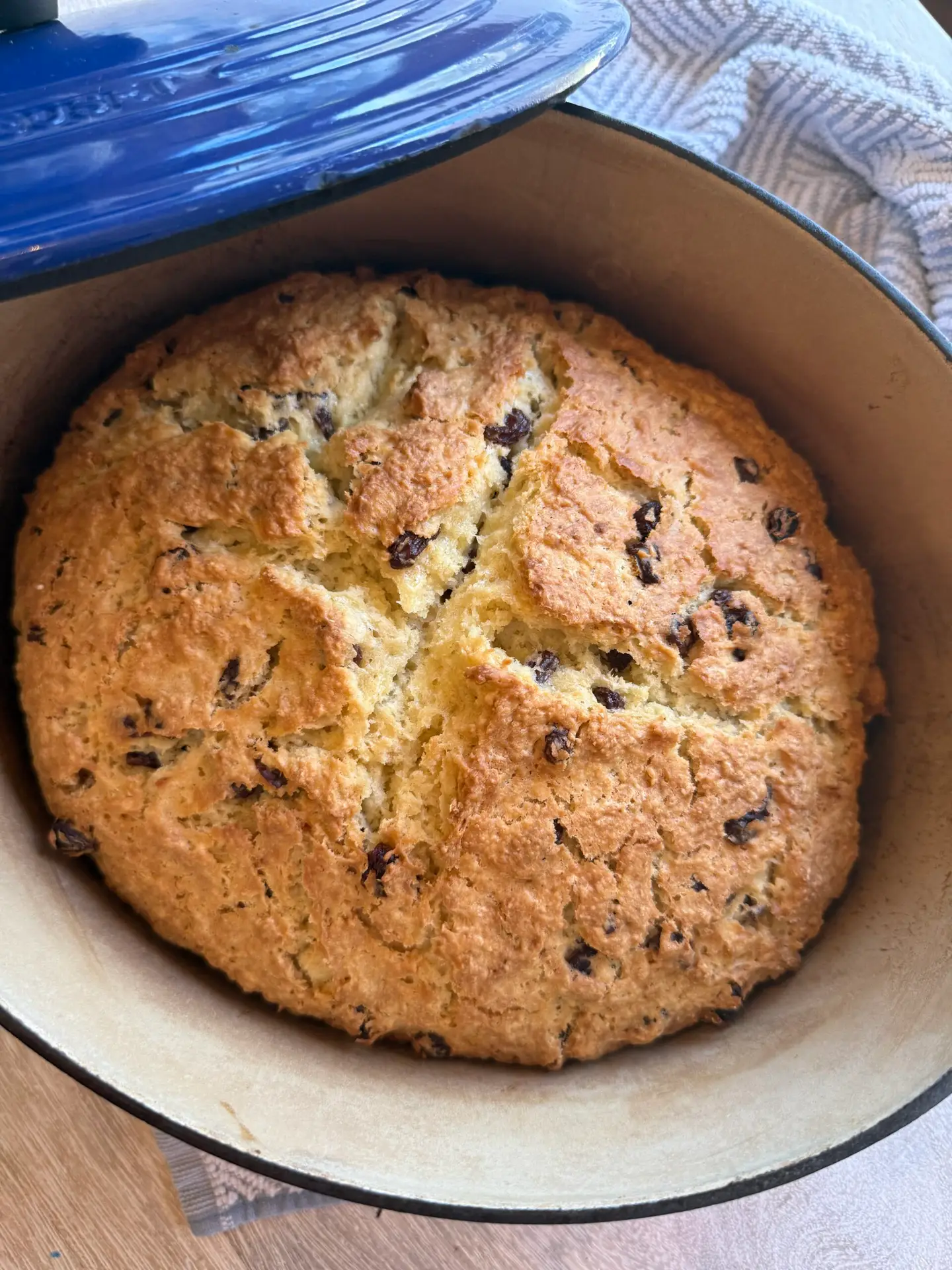
But the recipe everyone remembers most is her Irish soda bread, which appeared every year around St. Patrick’s Day.
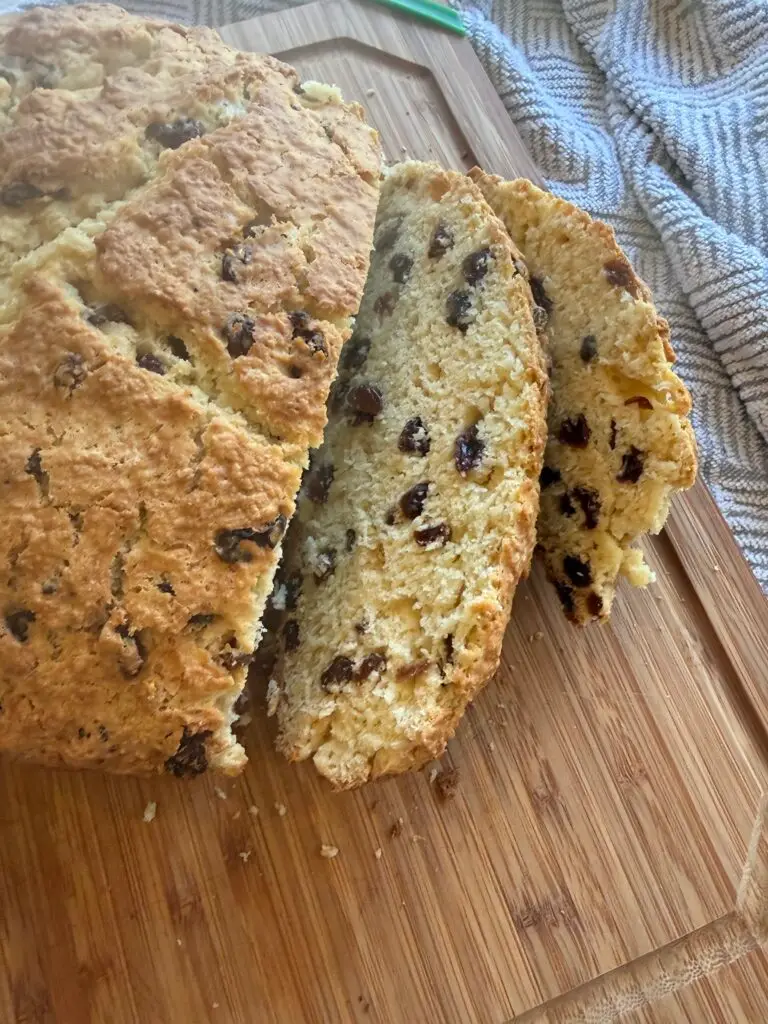
“We’d slather it with butter and have it with a cup of tea,” Maureen said. “And every year we’d think, why do we only make this once a year?”
(Link here to the recipe for Maureen Kelly’s Nana’s Irish Soda Bread.)
The Secret to Her Soda Bread
For years Nana teased the family that she would never share the recipe.
Eventually they convinced her to write it down.
“Honestly, soda bread is pretty simple,” Maureen said. “It’s basically a dump-and-bake recipe.”
But Nana’s version had a few distinctive characteristics.
“It wasn’t cakey. It was more dense, which I think is how it should be,” Maureen explained.
She typically used raisins (the dark kind – not the golden) and occasionally caraway seeds, though opinions on the seeds varied in the family. Maureen herself prefers to leave them out.
Another key detail was how the bread was baked.
“The real trick is the pot,” Maureen said. “She used a cast iron pot with a lid. That’s what helps it bake properly.”
Passing the Recipe Along
Today, Nana’s Irish soda bread has taken on a life of its own.
Friends across the country bake it every year and often share photos online.
“Every St. Patrick’s Day someone tags me in a picture of their soda bread coming out of the oven,” Maureen said. “It’s so fun to see Nana’s recipe spreading everywhere.”
For Maureen, making the bread brings back vivid memories.
“I always think of her,” she said. “After she passed away, my dad started making it every year too.”
Now the tradition continues between Maureen and her sister.
“I’ll send her a video when I lift the lid and the steam comes out,” she said.
Why Recipes Matter
As our conversation came to a close, I asked Maureen why recipes like this one matter so much.
Her answer was thoughtful.
“They keep the stories alive,” she said. “When you share the recipe, you’re also sharing the memories.”
She hopes the tradition will continue with the next generation.
“My great-niece is four years old,” she said. “I can’t wait until she’s old enough to make soda bread with me.”
A Final Thought
Before we finished talking, Maureen shared one final piece of advice.
“If you still have your parents or grandparents around, ask them the questions now,” she said. “Ask about their memories, their recipes, their stories. Don’t wait.”
It is a reminder that heritage often lives in everyday moments. A kitchen table. A family gathering. The smell of bread baking in the oven.
And sometimes the simplest recipes carry the richest stories.
If you would like to try baking it yourself, you can find the full recipe for Maureen Kelly’s Nana’s Irish Soda Bread here. It is a simple, traditional loaf that comes together quickly and fills the kitchen with the wonderful aroma of freshly baked bread. When you make it, you will be sharing in a tradition that has traveled from Nana’s kitchen to Maureen’s, and now perhaps to yours.